

Going viral is the best drug in the world.
There is no comparable rush to the dopamine spike when your post crosses the threshold and starts blowing up. It’s no secret that everyone wants to be popular and feel loved. When you go viral, it feels like you are being seen by the world and, in turn, validated on an incomprehensible scale. Yes, filling a stadium of thousands of people is cool, but what about millions of people telling you’re beautiful and hilarious?
If going viral is such a powerful drug, it’s important we make sense of it. We should learn how to harness virality so we can manufacture it and use it like a secret weapon; a tool to bring us closer to our goals. Understanding virality was how I sold my first app at 25, co-founded an entire media agency, and, more recently, went viral on LinkedIn after a dry spell.
I posted an absurd meme on LinkedIn, thinking it would maybe get 5,000 impressions. The team and I were surprised to see it exceeded 75,000. After months of the algorithm feeling like a black box, it started making more sense than ever. Even though the post’s success was unexpected, in hindsight, it had all the right elements.
The meme was of me dumping out an “intern’s” matcha latte and swapping it out for creatine. There were elements of relatability at play here: the trendiness of matcha and the gym-bro stereotype of startups. That alone could have been enough to create buzz, to have some sort of finger on the pulse of what’s hot / what gets people fired up, but then on top of that, it also had a realistic image that caught audiences off guard.
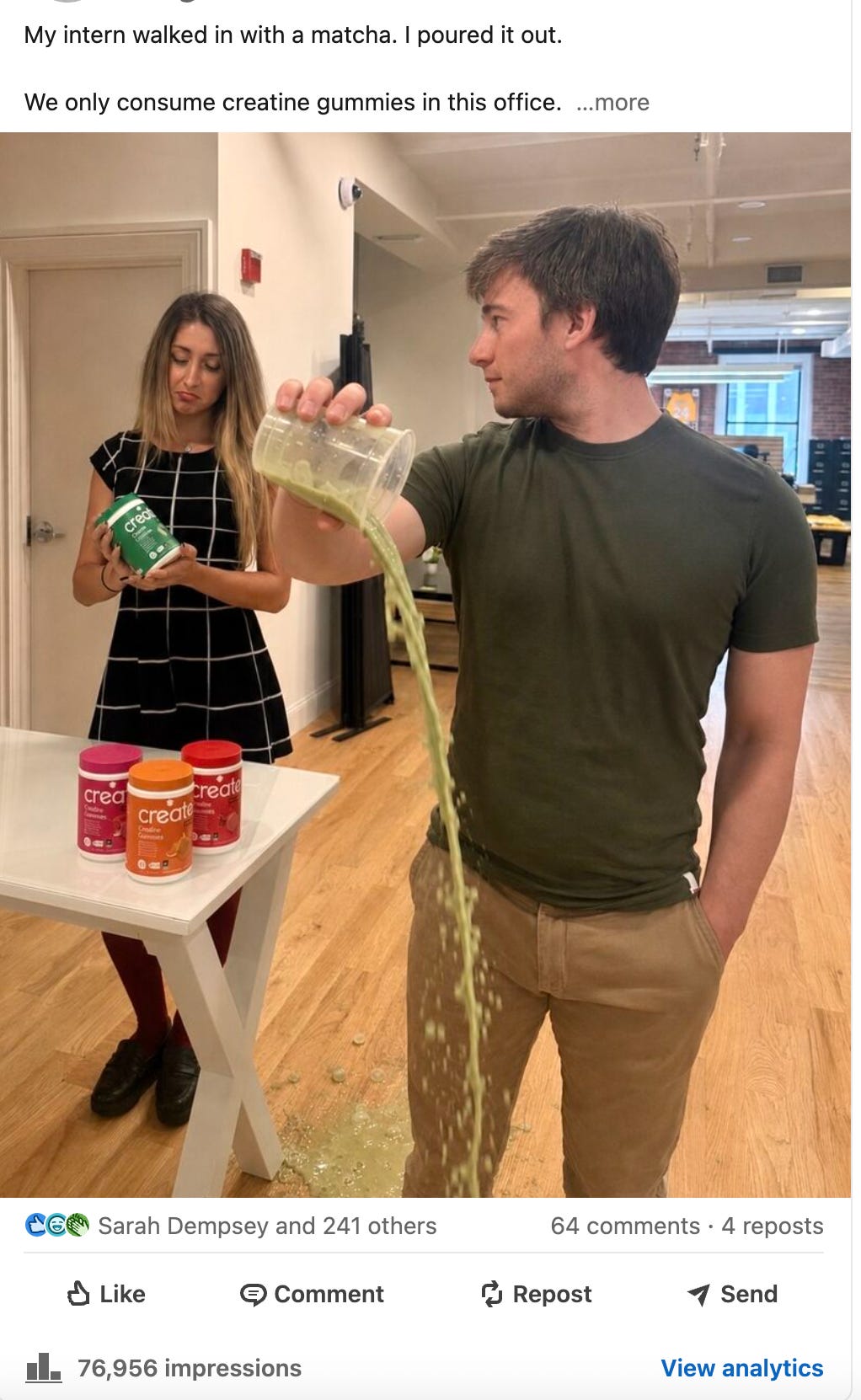
I was pouring out her matcha… all over the office floor. It broke the mold of what people expect on a more buttoned-up platform like LinkedIn. Being able to subvert people’s expectations on a platform while still staying within the constraints of how it works is a really important intersection to understand.
The sweet spot of virality is when you can simultaneously catch people off guard AND meet them exactly where they’re at.
Predicting virality is a muscle, and it’s a muscle fully capable of training. By spending enough time scrolling, your brain becomes a pattern matcher. Within a few seconds your instincts can spot potential virality in other people’s content. No matter what it is, educational or engaging or relatable, the post shows you something you didn’t know you needed. That feeling alone creates momentum, because if it’s happening to you, making you feel something, then you can guarantee that it’s doing that for other people. We’re really not so different at the end of the day.
Despite having spent the majority of my career consumed by the question of virality, much of it still feels like a black box. When it comes to making predictions about your own content, your pattern-matching instinct can fall short. It’s easy to be blindsided by your own content, and it is extremely difficult to be objective about your own creations. You’re very rarely evaluating the post itself from a blank slate. Usually, even subconsciously, your expectations and subjective experiences are all mixed up in the evaluation.
When it comes to predicting virality, there are things you can and can’t expect. Just about anyone can run statistical analyses with Claude these days. You can calculate a confidence interval using sufficient historical data. Yet, I’m more excited by the things that statistics can’t explain. There’s an extra virality coefficient that I started calling “The Tingles.” The Tingles totally transcend data, and they happen when a post escapes the range you could have ever calculated for it and takes on a life of its own; it’s a black swan event. It’s a much more elusive component of chance and human behavior. I think if a model could be built that factors in The Tingles, the entire game of virality would change.
Yes, going viral is a game, and social media as a whole is a game of status. Like any game, you are collecting something. You’re collecting followers, likes, comments, and impressions. As you win the game more and more, your objective changes, but no matter your objective, you’re communicating your truth on a mass scale, for free. It’s a skill that allows you to communicate in a way others can’t.
Virality is the biggest sum of human psychology case studies on the largest scale imaginable. Hundreds of thousands of individual decisions to watch, laugh, share, or scroll past. This entire world, made up of images and stories, is a game of attention. This entire economy is made up of attention. The better you understand attention, the more you can guide people where you want to go.
WEEKLY SHOUTOUT:
This week, I want to shout out my friend from literal day one, Max Zavidow. You may know him as @formerteenheartthrob. We met in pre-school, and reconnected when we were both in the city in 2021. It was a very full-circle reunion.
Max inspires me in many ways, especially in how instinctively he understands storytelling and virality. He clearly understands people deeply, and he makes me laugh harder than most can. Max left investment banking to pursue comedy and TikTok. His content is filled with surprise and plot twists, each one feeling like its own little fever dream. Lately I’ve been loving his ridiculous age-gap couple interview videos.

No matter what the content is, the guy thrives in front of the camera. He’s also an expert with deliberate planning and scriptwriting. He showed me the ways that storytelling is everything. He writes meticulous scripts with a fully fleshed-out story vision. The man plans a video the way most people plan a wedding.
NEWS:
Spotify is getting into the agentic coding game, which reinforces my belief that everyone and their mother wants to be a coding platform. They built Xirp, an internal system that lets engineers run dozens of coding agents at once, and jump between Claude Code, Codex, Gemini CLI, and open-source models without losing any context.
Mark Zuckerberg published a 6,500-word manifesto laying out Meta’s vision for personal superintelligence. His argument didn’t state anything entirely new. It was about how AI could make individuals and society collectively more powerful if we focused on everyone having access to the same tools. How everyone could eventually get a personal agent that understands their goals, relationships, health, career, and finances, and works for them 24/7.
People tend not to react well to manifestos. I can’t think of a time when anyone has released a manifesto that wasn’t somewhat put under a microscope. TechCrunch said that Zuck glosses over many of the real problems people already have with AI, highlighting the distance between how Silicon Valley talks about the AI future and how everyday people actually feel about it.
Gemini just passed 1B monthly users, putting the Gemini app alongside ChatGPT in user count. Google said that 63% of Gemini users are talking directly to the assistant through voice chat, and Gemini is generating more than 150M images every day. The funny thing is that I don’t know anyone who uses Gemini the most. It doesn’t feel like a billion-user product, culturally speaking.
That’s all for this week. If you’re bored this week, read through the Zuck manifesto and let me know what you think, become Gemini’s 1,000,000,001 user. Or start a coding platform.
Stay golden,
Z